This past summer in Geneva leaders from petrostates squashed attempts by the UN to come to an agreement on limiting plastic pollution. While many European leaders supported limiting production of this ecologically devastating polymer, the petrochemical industry promoted the mythical solution of plastic recycling and rejected any production caps.
I do my best to reduce plastics in everyday life: choosing glass jars at the supermarket, storing food in pyrex, drinking from a stainless steel bottle, even switching to silk dental floss. However, one thing from my plastic free routine has become increasingly difficult: picking my teeth with a wooden stick after eating out.
Stim-U-Dents, the classic matchbook size pack of triangular toothpicks, which used to be found at any chain drugstore, has disappeared from the shelves. Instead, one finds an array of plastic toothpicks–some with one inch pieces of floss, others with micro-brushes at one end. So what happened to my humble Stim-U-Dents?
After some haphazard googling, I decided this mystery might be a good test for an AI tool. I asked Gemini in deep research mode to write an essay on the history of Stim-U-Dents.
An hour later, I checked back to find it had popped out an 8 page paper. To be honest, it wasn’t bad. If Gemini was one of my students, I would give it a solid B. On the one hand, it provided extensive footnotes throughout the essay. On the other hand, these citations had a lot to be desired. First, it cited only the article title, website name and date accessed (which of course means all the articles had the same date!) Without authors or dates of publication, it is hard to know how old or how reliable the sources are. Moreover, many of these sources were very questionable. For example, it cited an Ebay listing for two packs of “Vintage Stim-U-Dent Toothpicks” from the 1940s (6.99 or best offer!) which claimed Stim-U-Dents were Patented in 1937 by Francis Grant of Detroit, Michigan. I contacted the seller to ask where they received this information (something I am not sure Gemini is capable of doing) and received no reply.
Another problem with Gemini’s essay was its vagueness around other dates in Stim-U-Dent history, something which frequently frustrates me when I find it in student papers. In particular, it failed to pin down when Johnson & Johnson acquired the brand. This is where I currently have a significant advantage over Gemini: my ability to search proprietary library databases. My favorite is Proquest, which has great coverage of historical periodicals. Of course, there are many papers, magazines and journals missing from Proquest that one can find through other databases. But as I often remind my students, even with the need to search multiple databases, historical research is still vastly easier than when I started my dissertation in the early nineties using hardbound periodical indexes.
When I searched Proquest, the earliest mention of Stim-U-Dents I could find was in The Detroit Free Press on July 10, 1935, under “Business Notes”:
The Fred M. Randall Co. advertising agents, Book Tower, Detroit is now directing the advertising of five new accounts. They are Stim-U-Dents, Inc., Detroit, manufacturers of a new, medicated tooth-space cleaner and gum stimulator; Michigan Tool Co., Detroit, manufacturers of machines and machine tools and gears: All-American Aircraft Show, to be held in Detroit from July 20 to 28; Banner Brewing Co., Saginaw. Mich., and the Automobile Trailer Division of The Aladdin Co., Bay City, Mich., manufacturers of “readi-cut” homes.
The article seems to confirm the product’s Detroit origins–but it predates by two years the patent date of 1937 claimed by the Ebay seller. Maybe the patent was granted after manufacture of the product began, but my research could find no reference to the patent or the supposed inventor Francis Grant.
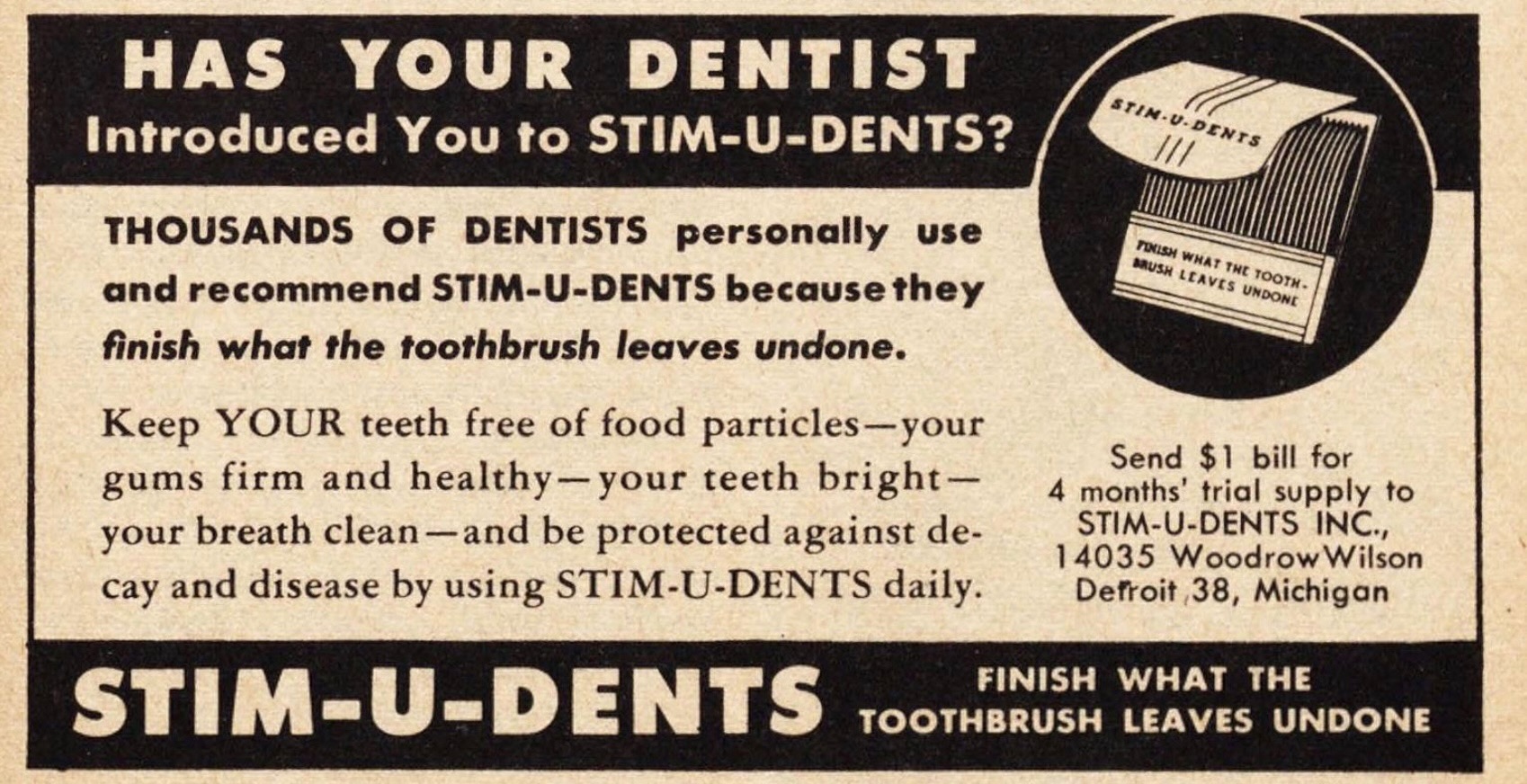
The first Stim-U-Dent advertisement that I could find appeared in The Battle Creek Michigan Moon-Journal on May 12 1938, in an ad for Babcock’s Economy Drug Store where Stim-U-Dents are priced at 25 cents. A national campaign emerged in newspapers across the country by the 1940s with the slogan “finish what the toothbrush leaves undone.” In 1958 the brand made its first appearance in a national magazine, Prevention, with the headline “See Magic in Your Mirror” that shows a woman smiling in the mirror at her clean teeth. It goes on to highlight “The Attractiveness of BEAUTIFUL TEETH-GUMS glowing with HEALTH–CLEAN BREATH–Protective aid against DECAY and DISEASE.”
Gemini’s essay claims that the date Johnson & Johnson acquired the brand is “not specified in the available records” but says ads as early as 1959 included the J&J name. Here my student essay would definitely be given multiple question and exclamation marks because the citation for this fact links to an Etsy search for “Vintage Johnson & Johnson advertising.” Browsing through these ads, I could not find a single one for Stim-U-Dent, let alone one indicating a publication date of 1959. My own research found a 1963 Johnson & Johnson Annual Report announcing the acquisition of Stim-U-Dents, so even if Gemini had found a vintage J&J Stim-U-Dent ad, clearly it could not have been from 1959.
The first advertisement I could find linking J&J to the product came from a 1967 recruitment ad in the New York Times with the title “Sales Management Creed” that begins: “To seek and attract to our organization the highest type of young men who have the qualities for a Johnson & Johnson career” at the bottom of which a list of companies includes “Stim-U-Dents, Inc.”
It was not until 1984 that Stim-U-Dents showed up as a Johnson & Johnson product in a national magazine ad, in this case Newsweek with the headline “HELP PREVENT GUM PROBLEMS.” This ad even included a coupon for 50 cents off! Over the next several years ads appeared in Prevention, Good Housekeeping, Woman’s Day, and Better Homes and Gardens. The last magazine ad I could find was from the September 1988 issue of Redbook.
References to Stim-U-Dent as a Johnson & Johnson product continued at least until 2009 when a column in Men’s Health responded to the question “Is brushing my teeth after every meal a good idea” by recommending, “If your mouth feels funky between meals, keep a pack of Johnson & Johnson Stim-U-Dent Plaque Removers on hand.” However, by that time, there is evidence that J & J had already sold the brand.
The question of when exactly Johnson & Johnson sold Stim-U-Dent is something I could not do much better answering than Gemini. The best I could do using Proquest was a 2009 news release announcing “The former Caldwell Consumer Health, LLC has been relaunched as Revive Personal Products Company” whose “oral care line includes Stim-U-Dent Interdental Cleaners.” This suggests at some point before 2009 J & J divested from the product.
Gemini described J & J’s sale of Stim-U-Dent in prose I would label vague fluff if a student turned it in:
The corporate history of Stim-U-Dents after its tenure with Johnson & Johnson is a complex, multi-stage narrative that requires careful deconstruction. The provided materials indicate a series of transitions that led to the brand’s current identity. An initial acquisition is documented in 2010, when Revive Personal Products Co. acquired The Natural Dentist, an oral care company. At the time of this transaction, the press releases noted that Stim-U-Dent was already a brand within Revive’s existing portfolio.
At the same time Gemini’s biggest blindspot comes when it describes Stim-U-Dent’s “Current Market Position” stating “It has maintained its dedicated user base by offering a product that is both familiar and effective.”
If you only look online, as Gemini was doing, Stim-U-Dents appear to still be widely available, but a closer inspection of the packaging at any website that sells the toothpicks reveals a problem. They read “Manufactured for Revive Personal Products Company Madison, NJ” with the website “www.stim-u-dent.com”–a website that is dead. Moreover, according to Gemini’s timeline, Revive was acquired by “The Natural Dentist” of Buena Park, CA in 2024, but the packets online say Madison, NJ.
Indeed, the expired domain name is the best indication of why the product has disappeared from physical drug store shelves. It suggests either they are no longer being made or the company in Buena Park, CA that supposedly purchased the brand has yet to start manufacturing them. What’s for sale online is just leftover stock.
However, I do have to give Google props in one area. When I searched for Stim-U-Dents in “nearby” stores on Google it told me there was a pharmacy in Park Slope that had it in stock. I called, and sure enough they had one left! I CitiBiked over in a hurry. On arrival, the cashier told me that they had been on back order for months, and she wasn’t sure if more were coming.
Another place where Google/Gemini deserves credit is in recognizing the environmental upside of the original wooden Stim-U-Dents. Gemini writes:
The product’s original choice of soft Basswood or American Linden is now a significant marketing advantage, as it is promoted as a “biodegradable wood from managed forests”. This inherent sustainability, likely a practical choice in the 1930s, now resonates with eco-conscious consumers, distinguishing the product from plastic floss picks and other synthetic alternatives.
Unfortunately, Gemini’s optimism doesn’t match today’s market reality. The U.S. has elected a leadership that is deeply antagonistic toward anything “eco-conscious,” rolling back incentives to improve the environment whether for purchasing electric vehicles or solar panels.
Several years ago a Methodist pastor friend of mine from Minnesota came to visit NYC. After a meal one evening, I pulled out my handy pack of picks and offered him one. “Are those Stim-U-Dents?” he asked. “My father used to always have those.” His father was also a pastor, and this led me to ask my mom, whose father was a Presbyterian pastor in Michigan, if she remembered grandpa using Stim-U-Dents. “I’m sure he did,” she confirmed.
These were the practical sensibilities of Midwestern country folk who raised backyard chickens, preserved garden vegetables and maintained household appliances for a lifetime–conservation was common sense. It’s tragic that their descendants, whose exurban lifestyles now carelessly consume rural America, have been convinced by so-called “conservatives” that environmentalism is a leftist conspiracy.
Another friend of mine who relocated from L.A. to Berlin told me that on a recent trip back to SoCal her biggest culture shock was the ubiquitous use of plastic utensils at restaurants. In Germany, apparently even the corner Döner Kebab shops use steel forks and knives. I hope to visit her sometime, and when I dine out, I will be sure to have my pack of Stim-U-Dents at hand.







 Paul Mason Fotsch