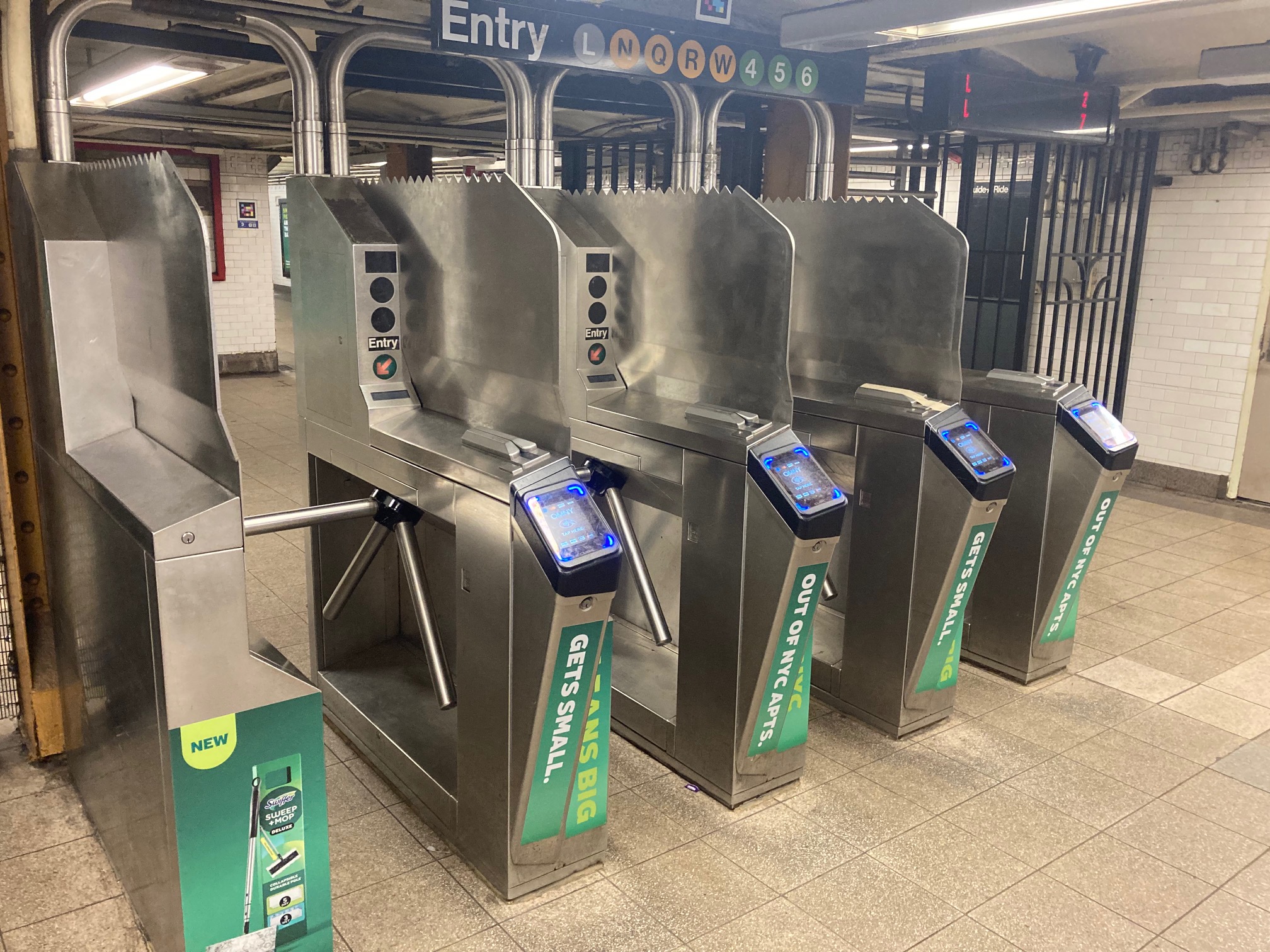
Back when I was living in L.A. I was active in an organization called the Bus Rider’s Union. At demonstrations we had an amazing array of chants in English, Spanish and Korean backed by a superb drum crew. One of my favorites contained the lines “We want fifty cent fares and twenty dollar passes, ’cause mass transportation is made for the masses!” I thought of this chant recently when Andrew Cuomo, in order to counter Mamdani’s plan for free buses, proposed free buses exclusively for low income New Yorkers.
Cuomo criticized Mamdani’s plan as a giveaway to the rich, but this is absurd on multiple levels. First, I am guessing that Cuomo doesn’t take the bus that often because it’s likely few residents in his luxury Sutton Place apartments rely on public transit. In fact, a 2017 study found the median income of bus riders was less than 30,000 and about 12,000 less than subway riders. But the larger problem with Cuomo’s proposal is its reliance on means testing for what should be a universal public good–like health care, education or housing. In the book Viking Economics George Lakey argues that a key reason for the success of the Scandinavian system is the principle of universality. High income earners support a relatively high tax burden because they benefit from the same quality services as low income individuals.
Of course, this doesn’t mean everyone should have access to a Range Rover for transportation. In fact, the automobile is perhaps the best example of social inequities when it comes to accessing basic needs. While Wall Street executives might ride around in giant black SUVs, working class New Yorkers stuff themselves onto the subway. And in almost every city outside of New York, the working poor rely on ancient sedans whose repair costs may cause sacrificing food or housing. Consider the thousands living out of their cars from the edge of Walmart parking lots.
In contrast to the automobile, mass transportation provides the same quality service to everyone who relies on it. Therefore, the wider the income group that uses it, the broader will be support for its proper funding. Yes, technically the rich can easily afford the cost of a subway fare, but a free fare might also encourage more wealthy people to take it and therefore use their political influence to get government funding for its improvement.
At the other end of the economic spectrum, there are many New Yorkers who struggle financially but who earn too much to qualify for a discounted subway fare. This gets to another problem with means testing for public services. It fails to benefit a large segment of the city just scraping by but not defined as poor. In contrast to the popular description of frequent turnstile hopping as a sign of “urban disorder” a better explanation is simply that the nearly three dollar fare is too expensive for the average commuter. At the same time, many fare evaders likely qualify for a discounted fare but the bureaucratic hoops are too cumbersome.
If the city does provide free transit, the question of course becomes how could it be funded? Well a good start is congestion pricing which, after many delays, was finally implemented this year. Some complain that this is a regressive tax that hurts poor people who rely on their cars. But the vast majority of low income New Yorkers do not own cars, and an even smaller portion take a car into Manhattan.
Another way to fund transit that has not received enough attention is to start charging for parking on New York streets. It is absurd that in a city with some of the most expensive real estate in the world we give free homes to private cars. Back in 2019, economist Howard Yaruss wrote an essay showing that “if the city metered each of its 3 million free parking spots and collected an average of $6 per spot per day, it could replace the approximately $6.5 billion per year in revenue lost from ending all fare collection.”
Like congestion pricing, metered parking would also make streets more convenient for buses and bikes and improve overall safety. It would also reduce the plague of double parking by encouraging more people to pay for off street parking or dump their cars altogether. The city recently added 500 new loading zones, which is vital since delivery trucks are so often forced to park in bike lanes, but I am afraid because drivers are so accustomed to free parking these zones are often ignored.
As another attempt to attack Mamdani, Cuomo has also called for means testing on rent stabilized apartments. Mamdani pays 2300 for a one bedroom apartment in Astoria, which Cuomo claims is unfair and should be going to someone who does not earn a 142,000 state assembly salary. Cuomo’s plan once again fails to account for the large number of New Yorkers who cannot afford market rate apartments but would not qualify for his income requirements.
Solving NYC’s affordable housing crisis might be even more difficult than providing free transit. After World War II the federal government provided enormous subsidies to suburban home buyers, helping to build the automobile centered development that dominates the U.S. In contrast, public housing in central cities was historically underfunded and became centers of concentrated poverty–especially for African Americans excluded from suburban homeownership. A very different model was revealed in a 2023 New York Times article by Francesca Mari examining the social housing of Vienna.
Dating back to the 1920s, Vienna has financed the construction of high quality public housing, which today 80% of residents qualify for. Thus, rather than including only the very poor, the Gemeindebauten, as they are called, welcome the middle class. Equally important, the superior design and amenities such as pools and saunas, make the buildings attractive to live in. Moreover, once you gain access to an apartment–the average wait is two years–you cannot be removed if your income goes beyond a certain level. This ensures the community remains economically diverse, and it can be seen as broadening political support for continued financing of social housing.
The New York state legislature is currently considering creating a Social Housing Development Authority that would finance housing in a way similar to Vienna. This new agency would issue tax exempt bonds to build permanently affordable apartments. A similar program called Mitchell Lama housing was established in the 1950s. Mitchell Lama financed coop buildings limited owners profit at resale thus keeping the apartments affordable.
In the United States, government funded services, including for transit and housing, have an image of being unattractive and something only the very desperate would choose to use. But this does not have to be the case in New York. If we create free public transit and affordable public housing for people of all income levels, we can build political support for maintaining these services at such a high standard that they will be sources of civic pride.
 Paul Mason Fotsch